Monday, February 1, 2010

Flossie Lewis in print!

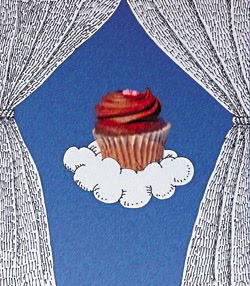
Susan Sanford's illustration for Flossie Lewis's essay in The East Bay Monthly

For those of us who studied English with Flossie Lewis as high school or college students in the Bay Area, and who read her published short fiction (in Commentary among other places) and writing how-to book (Getting Engaged: Falling in Love with your Paper), it's a welcome rare event to see the master in print. It just happened - Flossie's in the January edition of The East Bay Monthly. I didn't catch this early enough to get a copy on newsstands, but her essay - an affecting sensory snapshot of her daily life in Oakland, where she's been living for the past few years, in a retirement community called Piedmont Gardens - is online here.

Labels:

Wednesday, January 27, 2010

Rosencrantz & Guildenstern Are Dead


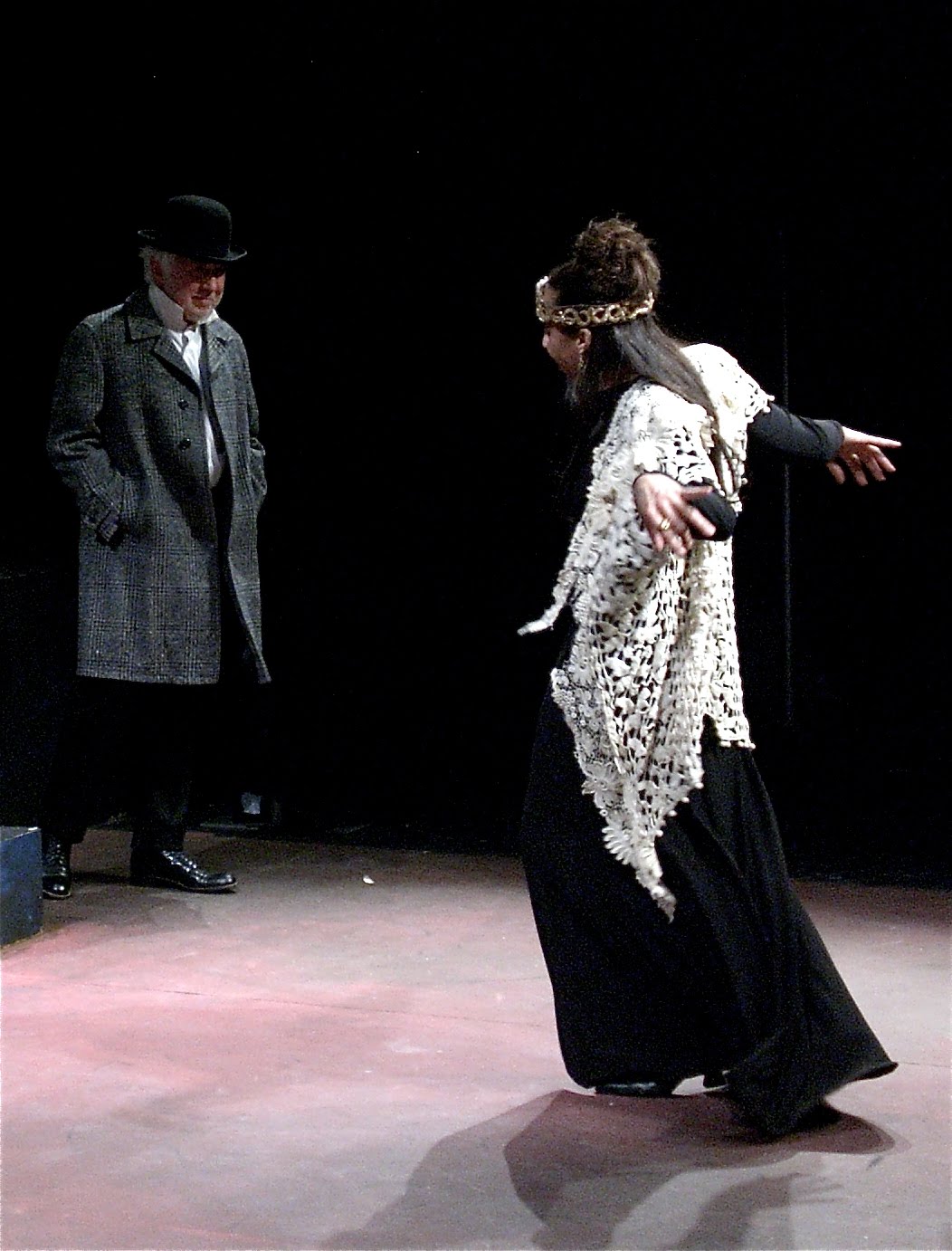
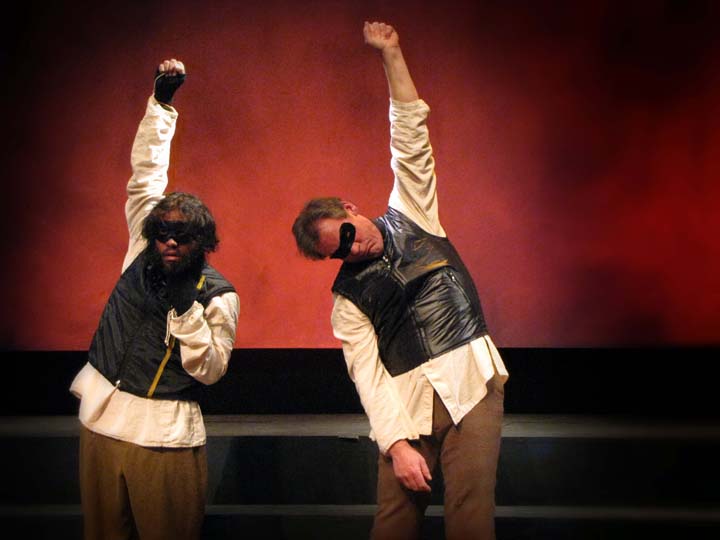
Alef Ayin and John Hilinski, as fellow tragedians, as two smiling accomplices, friends, courtiers - two spies (photo credit: Calvin Jung)


I haven't posted for a while, mostly in the interest of keeping quiet how farcically "365 consecutive days of uninterruptible bliss" has fallen short (because whoever you are, you are not my therapist). The only uninterruptible thing about this year has been my work schedule, editing video and doing archival research for the Rapt Productions theater documentary by day and going straight from there, most days, to rehearsals for the TheatreFIRST production of Rosencrantz & Guildenstern Are Dead, which opened this past weekend and runs through Valentine's Day. Rehearsals were at Berkeley Rep School of Theater, performances are at the black-box theater in the Fox Theater building in Oakland, Rapt is 6 blocks up Telegraph from there, so James and have found our usual whereabouts precisely reversed, with me calling him from across the bay or cutting out under it, and him at home with the doggy.


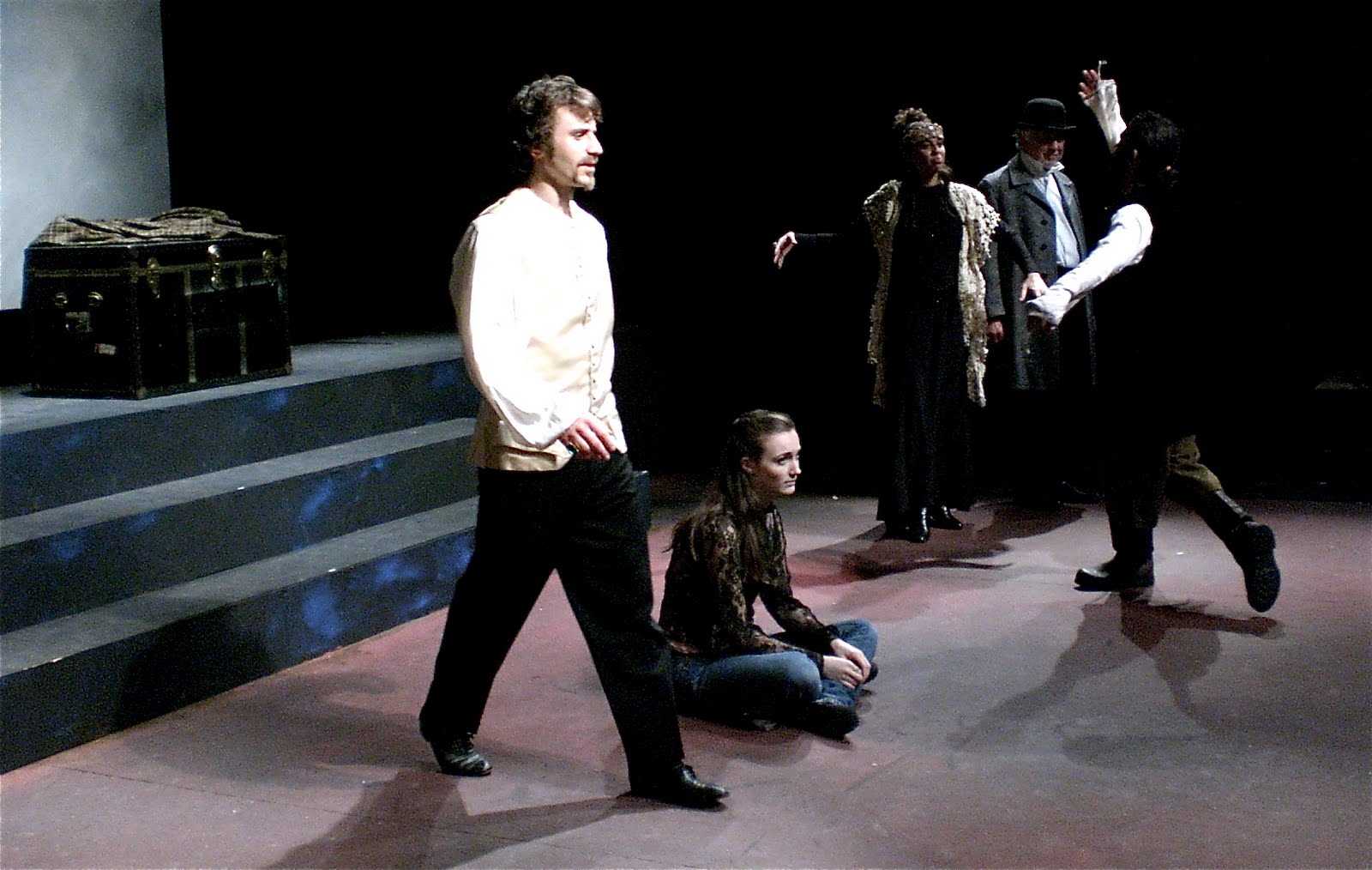
Andrew Hurteau as The Player pops out of a trunk aboard ship in Act III - behind him, on the ladder, is Harold Pierce as Hamlet (photo: CJ)

The last time I worked with this director and several of the actors, also as a violinist with a small dramatic role, was in the North Bay Shakespeare Company's production of Twelfth Night in 2007. That was staged at the old stone amphitheater at Hamilton Airfield and was about as fun as a Shakespeare comedy with a great director and a brilliant and amiable cast in a public park sounds. Downtown Oakland isn't quite as much fun, and neither is doing a play while holding down a job. But working with this group - especially now that that rehearsal schedule is receding into memory - has bounced me out of the deep and narrow space where uninterruptible bliss was meant to be. To anyone in the market for a good antidepressant, may I recommend a small part in a good play - even one about death.


Kalli Jonsson as Rosencrantz (photo: CJ)

Stoppard is my favorite living playwright based primarily on my experience of one production of one play - The Real Thing, which I saw twice in London and once in New York several years ago. I'd only seen a videotape of R&G before doing this one and was very glad to get the opportunity to know the play from the inside out. The production is great, but don't take it from me - here's yesterday's Oakland Tribune review. (My pull-quote from the review: "funny...equipped.")


Kalli and Harold with TheatreFIRST artistic director
Michael Storm, as Guildenstern (photo: CJ)

R&G runs through Valentine's Day - Thursday, Friday and Saturday nights at 7:30, Sunday at 2PM. It's a block from 19th St. BART and they're not checking IDs on the "under 30" pricing. More about the show and tickets here.


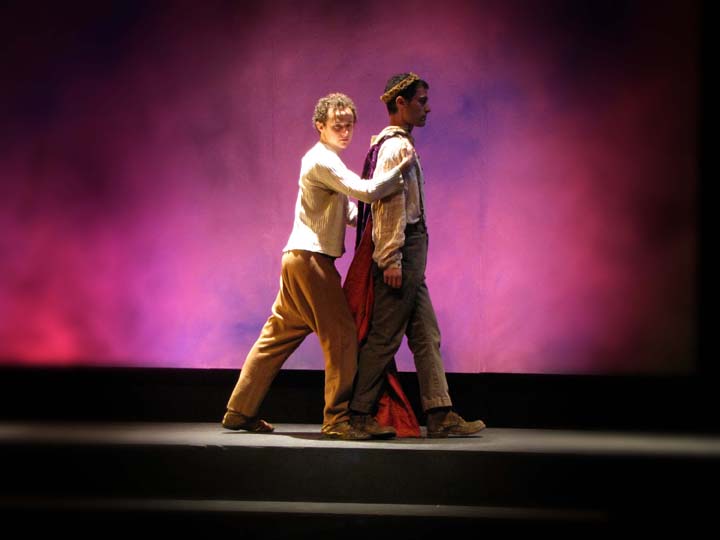
Graham Patzner and Paul Festa as tragedians as Player Queen and Player King (photo: CJ)


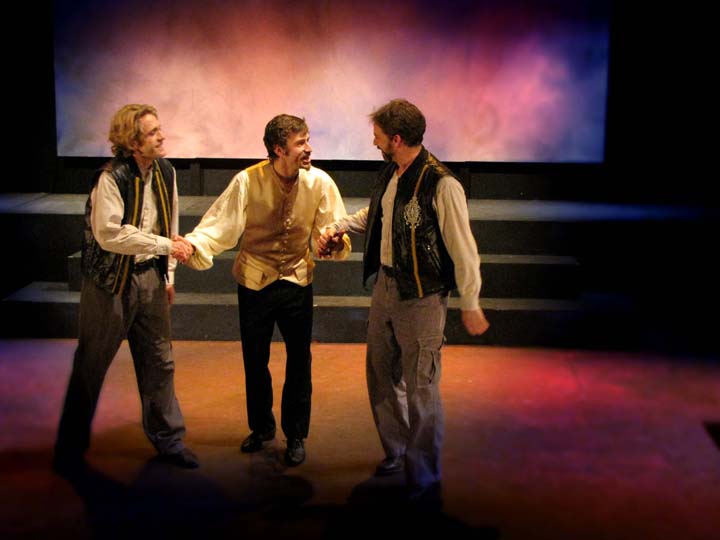
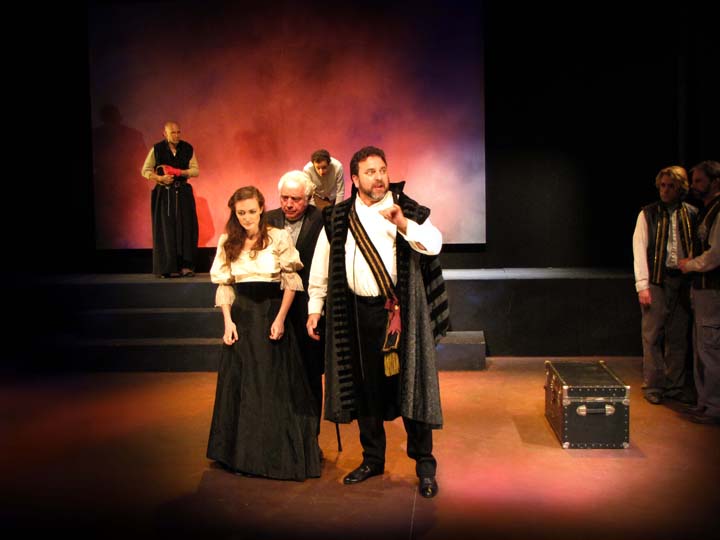
Left to right: G. Randall Wright (tragedian), Siobhan Doherty (Ophelia), George Killingsworth (Polonius), Graham, Chiron Alston (Claudius), Kalli and Michael (photo: CJ)

My own pix from rehearsals:


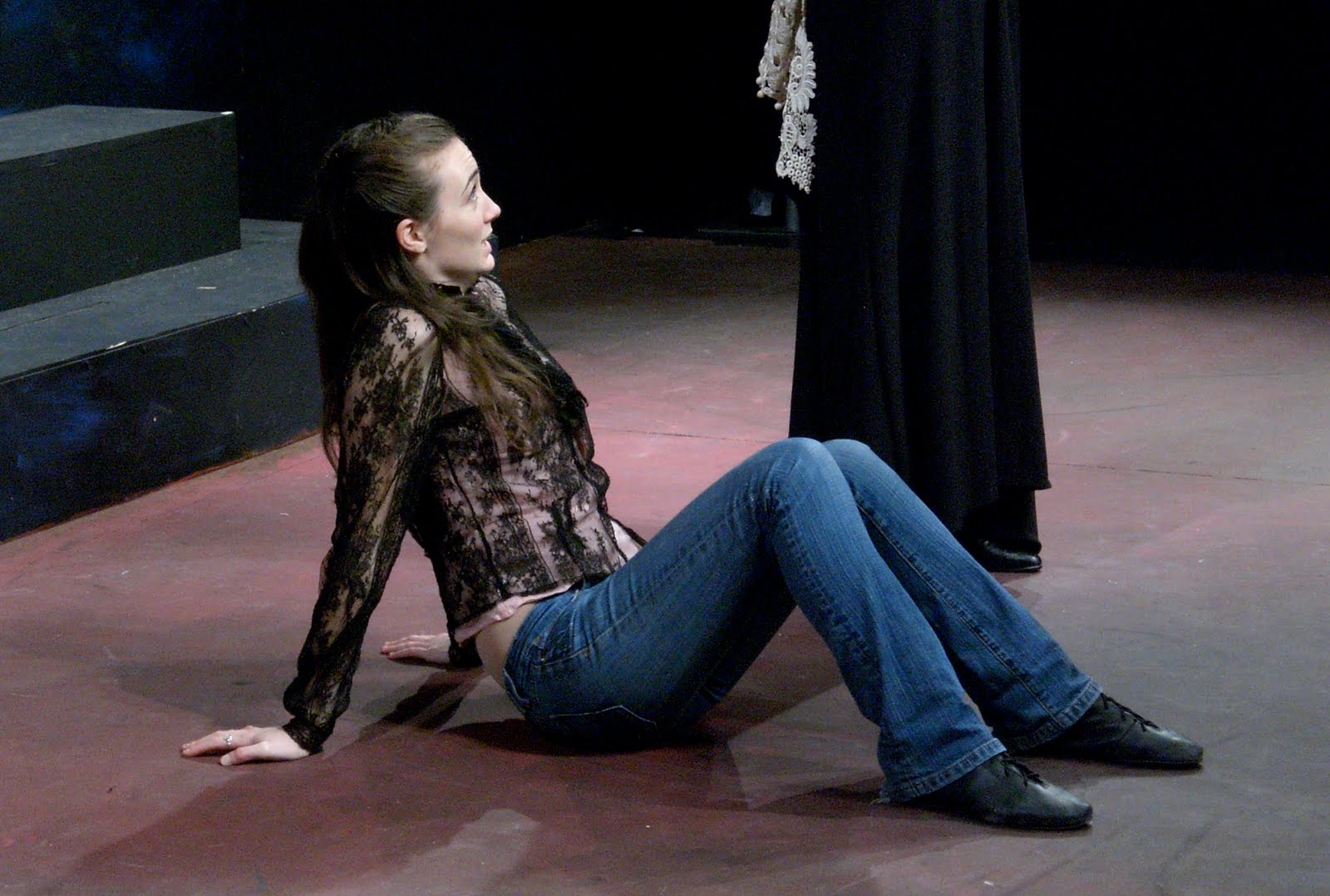
Natasha Noel (Gertrude)


Michael and Aleph


Labels:

Sunday, January 10, 2010

Voice


Without commentary, two observations about voice:
Mel Gussow: What kind of playwright are you?

Tom Stoppard: In general terms, I'm not a playwright who is interested in character with a capital K and psychology with a capital S. I'm a playwright interested in ideas and forced to invent characters to express those ideas. All my people speak the same way, with the same cadences and sentence structures. They speak as I do. When I write an African president into a play, I have to contrive to have him the only African president who speaks like me.

MG: What if you were writing an American play?

TS: All the Americans would have to be educated at Sandhurst or Christchurch - Rhodes scholars discussing John Wayne.

MG: Doesn't that limit you?

TS: It limits me in areas I'm not interested in expanding.

Mel Gussow:
Conversations with Stoppard
July 1979 interview


Nowadays the journalistic critical cliché about a young poet is to say that "he has found his own voice," the emphasis being on his differentness, on the uniqueness of his voice, on the fact that he sound like nobody else. But the Elizabethans at their best as well as at their worst are always sounding like each other. They did not search much after uniqueness of voice....It would hardly have struck them that a style could be used for display of personality.

Thom Gunn
Introduction to
Selected Poems of Fulke Greville
(as quoted by Colm Tóibín
The New York Review of Books, Jan. 14, 2010)

Labels: ,

Monday, January 4, 2010

Weird Scrabble

I had big plans for my first blog entry of 2010 , some combination of manifesto and multipart indictment and cry for help that would dispose of 2009 with appropriate violence, but trying to write about the last year at this distance feels like tapdancing in a tarpit, so here we are. Here I am, committing what in this household is a cardinal social sin: telling a Scrabble story. "Honey, you're telling a Scrabble story..." We suspect we've lost friends letting these slip in mixed company; conversationally they inhabit a zone somewhere between Margaret Cho routine reenactment and D&D reminiscence, and betray comparable interpersonal and psychological degeneracy.

Thanks to Facebook Scrabble, I play enough these days that I dream about the game. In this morning's dream, I had both the Q and the (Q), which in this dream version of the game was like a cross between a blank and a Q - but it was very unusual and lucky to get both Q and (Q) - it was a first. I woke up with a clear memory of the dream, so I had to make sure I wasn't still asleep and dreaming an hour later after I cycled through the morning's My Turn games to find this:

The screen shot convinces me pretty thoroughly that I was awake. I'm guessing it was a Flash glitch - the second Q vanished, along with several other tiles, when I reloaded the page. It's the first bug of that kind that I've noticed in about 100 games.

I am one of the most skeptical people I know when it comes to notions of the paranormal or the extrasensory or the prophetic, but I am officially counting this as weird, in the old sense of the word, whose ultimate root is "to become" -
weird which means "wayward," which means (OED) "fate, destiny...magical power, enchantment...the three goddesses supposed to determine the course of human life...one pretending or supposed to have the power to foresee and to control future events; a witch or wizard, a soothsayer...a supernatural or marvellous occurrence or tale...an omen or token significant of the nature of a future event; a prognostic..."

The larger entry about the turn of the year and decade will culminate in my pledge that 2010 will be 365 consecutive days of uninterruptible bliss, and let this be a correlative declaration, the egg custard
amuse-bouche of a haruspex: in 2010, I will have both Qs.

Wednesday, December 9, 2009

Middlemarch


A recent Facebook status update "finished Middlemarch" generated so much response in the comments that I could barely get a word in edgewise, which made me grateful I still have recourse to a blog.
I started Middlemarch mostly because Barry Owen wouldn't shut up about how great it was, and while Barry gives me frequently occasion to cite Emily Dickinson's observation that transport is not urged, this urged experience was in fact transporting. At least for the first few hundred pages, and again for the last hundred and change, leaving four or five hundred pages in the middle, a forced march if there ever was one. My paperback, after a week of rain in the Tennessee woods, began to enact the degradation of my interest, to the point that I was carrying the book around in two pieces and then in dozens, and by the time I got to New York I was leaving behind me in subway cars and cafes a Hanselesque trail of Victorian fiction, most of which I didn't expect to miss.

The Facebook thread saw people shouting out their favorite characters and this made me feel inadequate, because I had to think about it. The most popular choice and obvious candidate was the heroine, Dorothea, because she sacrifices a fortune for love (a development that will come as a genuine surprise to anyone who has never read a work of fiction), but she is a less obvious candidate because she is possibly the most perfectly moral Christian to ever lay a sincere claim on a reader's sympathy. Her religious faith and personal uprightness manifest themselves in perverse ways, so she earns plausibility as an eccentric; but I found myself too conscious of the fact that I was being asked to sympathize with a woman with a spotless soul, and every reader has her limits.

Dorothea reminds me of Milton's Jesus, poor schmuck, who winds up having the poem stolen out from under him by the far more entertaining fictional presence of Satan. In Middlemarch, much of the first two books (of eight) captivated me, but none of the characters or their fates really did until late in the book when Bulstrode, the Christian prig with a dirty secret of financial impropriety, is exposed and disgraced and his wife confronts him:

It was eight o'clock in the evening before the door opened and his wife entered. He dared not look up at her. He sat with his eyes bent down, and as she went towards him she thought he looked smaller - he seemed so withered and shrunken. A movement of new compassion and old tenderness went through her like a great wave, and putting one hand on his which rested on the arm of the chair, and the other on his shoulder, she said, solemnly but kindly -

"Look up, Nicholas."

He raised his eyes with a little start and looked at her half amazed for a moment: her pale face, her changed, mourning dress, the trembling about her mouth, all said, "I know"; and her hands and eyes rested gently on him. He burst out crying and they cried together, she sitting at his side. They could not yet speak to each other of the shame which she was bearing with him, or of the acts which had brought it down on them. His confession was silent, and her promise of faithfulness was silent. Open-minded as she was, she nevertheless shrank from the words which would have expressed their mutual consciousness as she would have shrunk from flakes of fire. She could not say, "How much is only slander and false suspicion?" and he did not say, "I am innocent."

Thumbing though the novel, it began to suspect that I wasn't always alone in my impatience with the life of the saint. Earlier in the book, the narrator insists on her own sympathy for the novel's first ogre, Dorothea's much older first husband, the dour and studious Reverend Edward Casaubon:

One morning, some weeks after her arrival at Lowick, Dorothea -- but why always Dorothea? Was her point of view the only possible one with regard to this marriage? protest against all our interest, all our effort at understanding being given to the young skins that look blooming in spite of trouble; for these too will get faded, and will know the older and more eating griefs which we are helping to neglect. In spite of the blinking eyes and white moles objectionable to Celia, and the want of muscular curve which was morally painful to Sir James, Mr. Casaubon had an intense consciousness within him, and was spiritually a-hungered like the rest of us. [...]

He had not had much foretaste of happiness in his previous life. To know intense joy without a strong bodily frame, one must have an enthusiastic soul. Mr. Casaubon had never had a strong bodily frame, and his soul was sensitive without being enthusiastic: it was too languid to thrill out of self-consciousness into passionate delight; it went on fluttering in the swampy ground where it was hatched, thinking of its wings and never flying. His experience was of that pitiable kind which shrinks from pity, and fears most of all that it should be known: it was that proud narrow sensitiveness which has not mass enough to spare for transformation into sympathy, and quivers thread-like in small currents of self-preoccupation or at best of an egoistic scrupulosity. [...] For my part I am very sorry for him. It is an uneasy lot at best, to be what we call highly taught and yet not to enjoy: to be present at this great spectacle of life and never to be liberated from a small hungry shivering self -- never to be fully possessed by the glory we behold, never to have our consciousness rapturously transformed into the vividness of a thought, the ardor of a passion, the energy of an action, but always to be scholarly and uninspired, ambitious and timid, scrupulous and dim-sighted. Becoming a dean or even a bishop would make little difference, I fear, to Mr. Casaubon's uneasiness. Doubtless some ancient Greek has observed that behind the big mask and the speaking-trumpet, there must always be our poor little eyes peeping as usual and our timorous lips more or less under anxious control.
Sexism may explain my impulse to always think of Eliot in terms of bridging Jane Austen and Virginia Woolf, but in my favorite passages I'm always conscious of that lineage. It has to do with the always shifting balance between satirical mordancy and affection. The narrator admonishes herself for neglecting Casaubon's point of view, his humanity, and then confesses her pity for him, which is an admonishment to us - for a weird, modern moment we are the target of her affectionate satire. Both of these maneuvers, to me, are twice as compelling as anything she attempts in the story of her 19th century St. Theresa.

So the novel's only characters I could deeply care about were its scoundrels in their undoings - Bulstrode primarily, and Casaubon, also exquisitely spoiled Rosamond in her protracted and fierce confrontation with the realities of her marriage, and most of the payoff comes in the final stretch. What makes the first few hundred pages so effervescent are the lighter barbs aimed at these denizens of the provinces:

Celia coloured, and looked very grave. "I think, dear, we are wanting in respect to mamma's memory, to put them by and take no notice of them. And," she added, after hesitating a little, with a rising sob of mortification, "necklaces are quite usual now; and Madame Poincon, who was stricter in some things even than you are, used to wear ornaments. And Christians generally - surely there are women in heaven now who wore jewels." Celia was conscious of some mental strength when she really applied herself to argument.

Here is the womb of Virginia Woolf's feminism:

A man's mind - what there is of it - has always the advantage of being masculine - as the smallest birch-tree is of a higher kind than the most soaring palm - and even his ignorance is of a sounder quality. Sir James might not have originated this estimate; but a kind Providence furnishes the limpest personality with a little gum or starch in the form of tradition.

And in Mrs. Waule's inheritance anxiety, the resonance of the opening line of Pride and Prejudice:

...there remained as the nethermost sediment in her mental shallows a persuasion that her brother Peter Featherstone could never leave his chief property away from his blood-relations: - else, why had the Almighty carried off his two wives both childless, after he had gained so much by manganese and things, turning up when nobody expected it? - and why was there a Lowick parish church, and the Waules and Powderells all sitting in the same pew for generations, and the Featherstone pew next to them, if, the Sunday after her brother Peter's death, everybody was to know that the property was gone out of the family? The human mind has at no period accepted a moral chaos; and so preposterous a result was not strictly conceivable. But we are frightened at much that is not strictly conceivable.

One last favorite line with special pertinence to the unpublished novelist's criticism of Eliot:

...very little achievement is required in order to pity another man's shortcomings.

Labels:

Sunday, November 29, 2009

Juliette Ideler White 1922 - 2009


Juliette Ideler White
1922 - 2009


Juliette died this afternoon a rich and full year after her lung cancer diagnosis. In that year she went through the Panama Canal, explored Mexico, checked out the Hermitage, and went to a lot of parties in her honor. Nearly to the end she was entertaining guests in her little house on Albion Ridge, taking care of us as much as if not more than being taken care of. Juliette lived until she died.

Two of Juliette's granddaughters kept a blog of her final days that will have a eulogy and any further information. I've posted a Facebook tribute page (Juliette Ideler White Tribute) with a treasury of her photographs (with more to come) and a video friends posted of photos with Juliette playing the soundtrack.


Juliette Ideler White and Paul Festa
portrait by Greg Gorman, 2009


The last letter I wrote Juliette captures something of what I felt for her and feel for her memory:


Tuesday, 17 November 2009


Dear Juliette,

Aren’t we cute? You with your chanterelles, me with my Amanita calyptroderma. I cleaned and chopped them all Sunday night when we came home and yesterday James made a year’s supply of mushroom cream sauce. I sautéed more for lunch with leftover beef and Brussels sprouts and some chicken sauce and penne pasta. Three intact caps await stuffing. Sarah Silverman said that when God gives you AIDS, make lemonAIDS, and contemplating what she would say about mushrooms – on second thought maybe I’d better not. Meanwhile, despite excellent digestion after eating these now for four days in a row, I remain creeped out by the Chronicle story people keep forwarding me, about the Lodi family that wound in a hospital waiting for new livers after harvesting Amanita phalloides last week. The story carries a picture of the offending mushrooms and they look just like these. Was it your book or one of the Websites I looked at that added that the Death Caps are delicious?

Speaking of death, I got Rosencrantz and Guildenstern Are Dead out of the library and wouldn’t you know it, the musical tragedians (of which I am one) have not one single fucking line. But I signed on. Doing Twelfth Night two years ago was outrageously fun and this is a reunion of that cast and director.

I loved our last weekend together, being with you and your family, having you at the party, vertical or horizontal as the case may have been – it occurs to me that I might not wait until my final illness to order my bed put in the dining room. My last weekend with you was like all the rest in a crucial respect, because, odd as it might sound (to some, but not to me), despite the circumstances it was fun, and it was fun because even in dying you still know how to live, and you’ve taught that by example to me and to everyone around you. I couldn’t be sad in your presence. Back home, awake with my new insomnia, much different story. But with you I was happy, and you were so much more alive than dying, though you were and are teaching, by example, how to do that too. Like putting the bed next to the dining room table, by the window looking out on the rhododendrons and the tree whose name you taught me last visit and which I can’t remember now – some lessons stick better than others.

Fun with photos and mushrooms and granddaughters and a garden party – too much fun to want to interrupt it with sentimental declarations but I’ll risk one now. I was always happy in your presence. Twenty or thirty years of happiness, of carting my friends and boyfriends and parents and husband up the coast to share it, like showing them where the chanterelles come up. I think it was Saturday night that I dreamed I was in the forest at dusk and the place was alive with the sentient spirits of mushrooms. It wasn’t the mushrooms themselves but the spirits of them, in the redwood canopy winking light and communicating something to me that was joyous and exalted. While you’re still here to read this I have to thank you for all the joy.
Saturday, November 7, 2009

Incoming! Karen Hartman


Playwright and Apparition of the Eternal Church star Karen Hartman is headed to San Francisco, Stanford, and back home to New York for readings of her new play. Here are the details - I'll be at the Tuesday night show directed by Cal Shakes director (and George's son) Jon Moscone.

Goldie, Max, and Milk

A comedy about learning to do what comes naturally

Max, a single lesbian, just gave birth. She’s unemployed, with a house that’s falling apart, an ex on the loose, and no clue how to nurse her four-day-old baby. Can Goldie, an Orthodox Jewish lactation consultant, guide Max into motherhood? Or will conflicting family values get the better of them both?

***
Monday, November 9, 7:30pm at Stanford University CERAS Hall
Contact David Goldman for more information at davidg1@stanford.edu

Tuesday, November 10, 7PM
ACT's Hastings Studio, 30 Grant Street, 6th Floor
Free. For reservations:
Jill@playwrightsfoundation.org

Thursday, November 19, 4PM
New York 11/19, 4pm, directed by Leigh Silverman. newdramatists@newdramatists.org